Showing posts with label trans. Show all posts

Saturday, October 18, 2025

A Revolution of Common Sense: Book Review


In A Revolution of Common Sense, Scott Jennings delivers a passionate and unapologetic defense of Donald J. Trump and the political movement he represents. Framed as both a chronicle and a declaration of purpose, the book examines Trump’s rise, his reentry into Washington, and what Jennings describes as his mission to restore “common sense” to American politics and to defend Western civilization itself.

Jennings, a conservative commentator and political strategist, approaches his subject with clear admiration. The tone of the book is assertive, direct, and energetic, capturing the spirit of the Trump era as seen from within the movement. Rather than a detached political study, this work positions itself as an insider’s narrative—one that praises the former president’s determination, criticizes entrenched bureaucratic resistance, and champions the populist energy that brought Trump to power.

The title encapsulates Jennings’s thesis: that Washington, in his view, had lost touch with ordinary Americans and the straightforward logic that once guided public life. “Common sense,” as he defines it, means practical, results-oriented decision making unburdened by political correctness or ideological caution. The book argues that Trump’s appeal lies in his ability to voice what many citizens already felt—that government had grown distant from everyday reality and needed a shock to its system.

A major theme of the book is the concept of defending Western civilization. Jennings portrays Trump as a modern defender of traditional values, national sovereignty, and cultural identity in an age of global uncertainty. He contends that the preservation of these values requires courage, defiance of political elites, and a willingness to stand apart from the mainstream. The language is dramatic, emphasizing struggle and conviction, and the narrative often paints the administration’s battles as larger than politics—symbolic of a broader cultural clash.

For readers who already admire Trump or identify with his movement, Jennings’s book is both affirmation and celebration. It offers moments of behind-the-scenes storytelling and a sense of proximity to the political action. Jennings uses his connections within conservative politics to paint a picture of a leader who is both determined and misunderstood, operating within a system that resists his reforms at every turn.

However, the book’s strength as a passionate defense may also be its limitation. Jennings does not attempt to offer an evenhanded assessment. His admiration for Trump is unwavering, and his framing leaves little room for critique or nuance. Readers seeking balanced political analysis or independent verification of key events may find the book more polemic than investigation. The prose often favors intensity and conviction over evidence or reflection.

Despite this, Jennings’s writing is engaging. His pacing keeps the story lively, and his straightforward style matches the “common sense” ethos he praises. The narrative’s vigor makes the book accessible even to those who are only casually interested in politics. Its clear alignment with a particular worldview ensures it will resonate deeply with its intended audience, even as it alienates those who disagree.

A Revolution of Common Sense stands as a reflection of its time—a work meant to energize, rally, and reaffirm rather than persuade skeptics. It fits comfortably within the body of pro-Trump political literature, aiming less to analyze history than to shape its perception. For supporters, it will feel like a validation of long-held beliefs. For critics, it will serve as an example of how the Trump movement continues to define itself through narrative and symbolism.

In summary, Scott Jennings has written a spirited and partisan account of the Trump phenomenon. The book’s power lies in its conviction and its refusal to equivocate. It is not a work of balanced journalism but rather a statement of faith in a political vision that sees itself as restoring order, clarity, and traditional strength to an uncertain age.

For readers aligned with that vision, it may be an inspiring and energizing read. For those outside it, it remains a revealing glimpse into how Trump’s supporters continue to frame his role in America’s ongoing political story.

Get A Revolution Of Common Sense On Amazon!

Tuesday, October 14, 2025

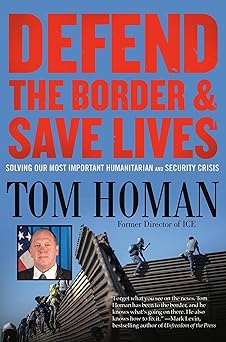
Defend the Border and Save Lives: Solving Our Most Important Humanitarian and Security Crisis -Review


Tom Homan, former Acting Director of U.S. Immigration and Customs Enforcement (ICE), brings decades of frontline experience to his book Defend the Border and Save Lives. In this work, Homan argues that the border crisis facing the United States is not merely a political or logistical challenge but a profound humanitarian and national security emergency. The book blends personal experience, policy analysis, and moral conviction to advocate for a renewed, disciplined approach to immigration enforcement.

Homan begins by explaining the scope of what he calls the border’s “humanitarian disaster.” He recounts real-life stories from his time on the ground, including encounters with human traffickers, cartel smugglers, and migrants who suffered greatly during their journeys. Through these stories, he emphasizes that illegal immigration is not a victimless act—it often results in suffering, exploitation, and loss of life. His experiences illustrate how criminal networks profit from chaos and how weak enforcement encourages more dangerous journeys for migrants seeking entry into the United States.

From the start, Homan presents his case in plain, direct language. He takes the reader behind the scenes of immigration enforcement, revealing both the challenges and frustrations faced by officers and agents tasked with securing the border. He criticizes what he sees as the inconsistent policies of multiple administrations, arguing that political agendas often override the safety of both migrants and American citizens. His central message is clear: effective border enforcement saves lives by discouraging dangerous illegal crossings and disrupting the criminal enterprises that exploit vulnerable people.

The book is organized around several core themes. The first is Homan’s diagnosis of the crisis. He describes a system overrun with loopholes, policy reversals, and political indecision. He argues that lax enforcement and policies that encourage illegal entry have transformed the border into a humanitarian nightmare. He connects these failures to issues such as drug trafficking, human smuggling, and the spread of organized crime, portraying the border as a major front line in the defense of national security.

The second major theme focuses on debunking what Homan sees as misconceptions about immigration and enforcement. He challenges the belief that strict border control is inherently anti-immigrant, insisting that a secure border protects both citizens and migrants. He portrays border enforcement as a moral duty, meant to save lives by preventing exploitation and dangerous crossings. This humanitarian justification underpins much of his argument and separates his stance from purely political rhetoric.

A third section of the book is dedicated to Homan’s firsthand accounts. Drawing from decades of experience, he shares stories that illustrate the human costs of weak policies. These anecdotes are both personal and persuasive, describing moments of rescue, loss, and confrontation with organized crime. His storytelling gives readers a sense of the human element behind the statistics, reinforcing his message that compassion and enforcement must coexist.

In the final chapters, Homan outlines his proposed solutions. He calls for increased resources for border agents, expanded physical and technological barriers, mandatory E-Verify for employers, and the closing of legal loopholes that he believes encourage illegal entry. He advocates for a national commitment to immigration law that combines humanitarian compassion with firm enforcement. Homan also emphasizes accountability among policymakers, arguing that political leaders must stop using the border as a talking point and start treating it as a national priority.

One of the book’s greatest strengths is Homan’s credibility as an experienced law enforcement official. His career provides him with real-world authority on border issues, and he speaks with the confidence of someone who has seen the problem firsthand. His writing is straightforward and accessible, appealing to readers who want practical insight rather than abstract theory. The moral clarity of his argument—that secure borders protect everyone involved—is likely to resonate with readers who value both security and compassion.

However, the book’s weaknesses stem from its strong partisan tone. Homan’s unwavering stance and combative style may alienate readers who prefer a more balanced analysis or who approach immigration from a humanitarian or economic perspective. While his personal experiences are compelling, the book offers limited engagement with counterarguments or deeper discussions of root causes, such as poverty, instability, or foreign policy. Readers looking for a nuanced academic treatment of immigration policy may find the book too one-sided.

Despite this, Defend the Border and Save Lives succeeds as a passionate and persuasive call to action. Homan’s writing is fueled by conviction and firsthand experience, and his emphasis on the humanitarian aspect of border security is both unexpected and powerful. His central message—that enforcement and compassion are not opposites—sets the book apart from purely political commentary. He argues that turning a blind eye to illegal immigration leads to more suffering, not less, and that protecting the border is ultimately an act of moral responsibility.

This book will appeal most to readers who believe that the United States must take a stronger stance on border enforcement, as well as those interested in understanding how frontline officers view the crisis. It is not an academic study but a personal manifesto rooted in experience and emotion. For readers seeking to understand the border debate from the perspective of those who have lived it daily, Homan’s book provides an unfiltered, impassioned, and deeply personal viewpoint.

In conclusion, Defend the Border and Save Lives is a forceful defense of border security framed as a humanitarian cause. Tom Homan’s firsthand experience, direct language, and moral conviction make the book a compelling read, even when its tone becomes partisan. It is both a warning and a call to action, urging readers and leaders alike to confront the realities at the border and to recognize that securing it is, in Homan’s words, a matter of saving lives.

Get Defend The Border And Save Lives On Amazon!

Created Equal: The Painful Past, Confusing Present, and Hopeful Future of Race in America — A Review

Ben Carson’s Created Equal is part memoir, part primer, and part polemic: a book that seeks to reframe the American conversation about ra...